RCT is looking for a qualified tradesperson to join our dynamic team in Kewdale, Western Australia.
RCT are the leader in mobile mining automation technology, and we are looking to build the technical team who are responsible for the design of specialised projects.
Start your career now with RCT!
What we’re looking for:
Everything you need to know about the role:
RCT is the global leader in designing Smart Technology for mobile mining and Industrial equipment. We are the leading provider of Automation and Control solutions for all mobile equipment in the mining industry. We have an extensive range of solutions spanning five sub-brands, all of which deliver our clients increased productivity, profitability, and safety.
If you enjoy being on the go and working in a small friendly team, then this is the job for you!
If you would like to be considered for this position, please email your cover letter and resume to: xxxxxxxxxx@xxx-xxxxxx.xxx
An Automation Journey (4:22min)
RCT’s autonomous technology solution for surface-based mobile mining equipment is taking shape thanks to the hard work and innovation of some of our brightest minds from across the company.
The new solution forms the next major step in our autonomous technology offering for global mining companies, who for decades now have benefitted from our Line-of-Sight, Teleremote and autonomous underground technologies.
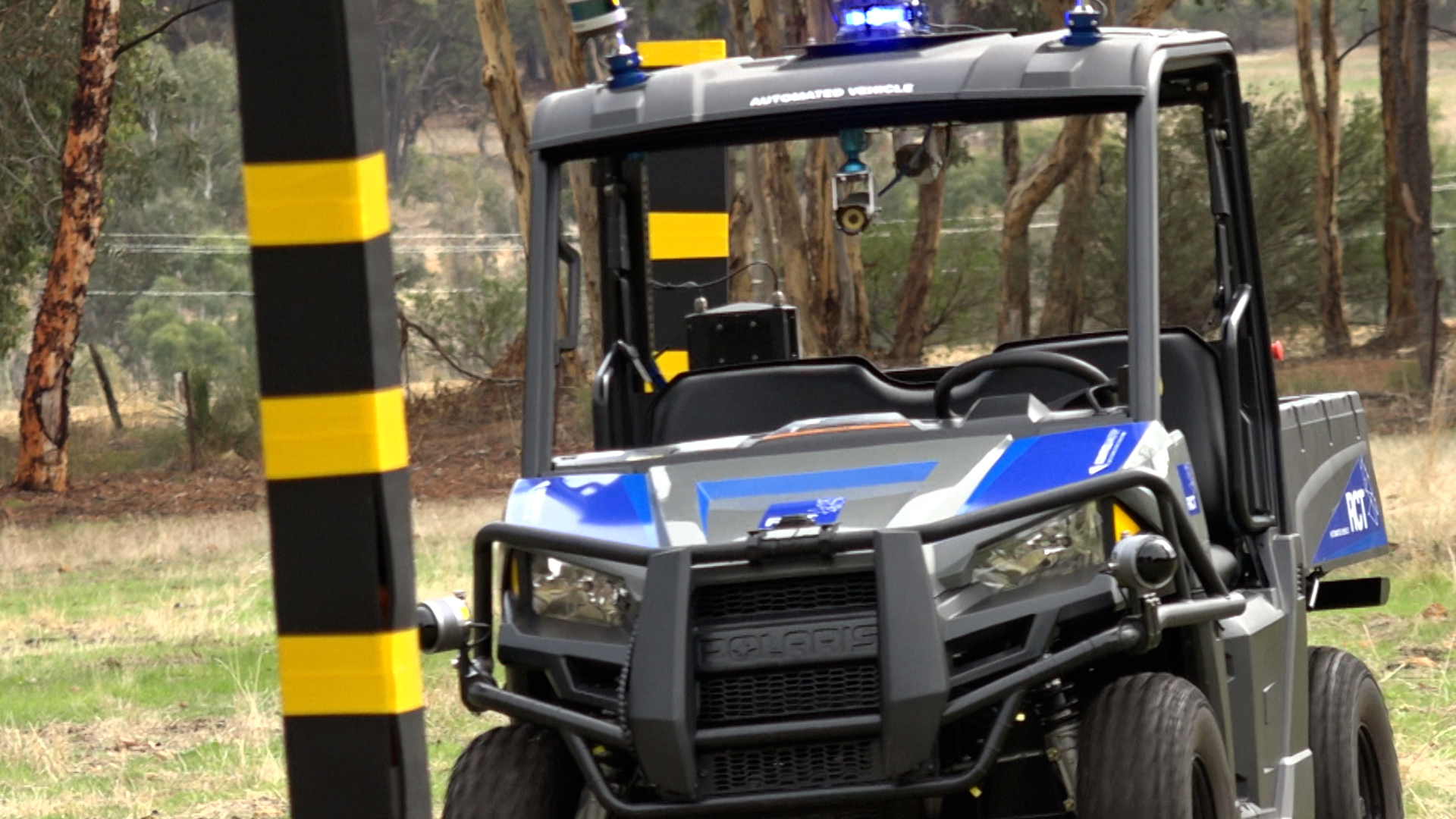
The autonomous package has been fitted onto a Polaris ATV which is being used as a testbed for our collection of LIDAR, GPS and data technologies.
The work is being spearheaded by Kevin Winchester for Product Management, Tom Egling from PoCWorks and Jayden Rickert from Operational Technologies. Head of Product Management Brendon Cullen says the Polaris will showcase the solution to clients.
“Going forward, we can easily demonstrate the Polaris’ capabilities and show that our technology integrates with a battery electric vehicle, which is an area of interest for many mining companies.”
“We can put the Polaris through its paces locally and test scenarios and access data without having to access a mine so testing on a smaller, more compact vehicle it is a lot more beneficial for our workflow.”
Brendon said they are developing the solution to integrate with dozers and wheel loaders to suit niche applications, with the first dozer solution to be deployed within a year.
“By rolling out this technology on a mine our clients will start to see enhanced fleet activities and improved productivity whereas our LOS and Teleremote solutions were more focused on safety improvements.”
The digitisation field has grown significantly in recent times and it continues to advance and adapt to meet the demands of mining companies around the globe.
The mining industry in general is highly variable due to external factors such as commodity prices, declining ore grade quality, rising labour costs, pressure of new markets, depleting reserves in some commodities (e.g. Tier 1 Gold producing mines) (Exhibit 1) and the fact it takes place in extreme conditions in remote locations. With so many factors to consider, companies place a huge importance on streamlining operations in order to remain profitable throughout these cycles.
The push towards digitisation in the mining industry is huge. Not only is it used to optimise processes and maximise the value of a company’s existing applications but it also looks at the emerging technologies used to help mining companies optimise their investments on equipment while safeguarding operators.
As a result, the majority of mine site workers are carrying out day-to-day functions very differently to how they did even 10 years ago. This is due to companies leveraging the technology available to improve processes across the board. This in turn has seen companies remodelling their strategies and business models accordingly.
Therefore, it comes as no surprise that digitisation in mining has accelerated at a pace not previously seen.
The biggest change of all that has come about with digitisation is the introduction of automation and information systems. This has seen miners being re-located from the cab of machines to automation centres where they can control their machines with all the same functions from the comfort and safety of an ergonomic chair safely located away from the mine face.
In addition to this, real-time information has become readily accessible, making data more prevalent to make positive changes.
Digitisation has completely transformed the mining industry as a whole and has seen companies being able to achieve positive outcomes in key areas including:
Digitisation encompasses so many things on so many levels;
it is not just simply about connecting to a network.
Exhibit 1
“Digitising the mining process changes it from a manual, paper-based operation to a digital platform that incorporates siloed systems, automation, AI, ML and DML to streamline operations and significantly improve business outcomes.”
Utilising proven systems to help process data is becoming progressively important in providing real-time decision support and future projections for mining companies. Advanced data and analytics add real value to mining operations by identifying hindrances – after the fact or by predicting where issues are likely to arise in the near future and avoiding them altogether.
The use of sensors improves this data capture and together with reporting it allows companies to make faster, more informed decisions to help streamline operations by removing inefficiencies.
The saying is “information is power” and it rings true when applied to the mining industry. If management is provided with accurate, real-time information about their fleet, they are able to better monitor its performance. This is particularly useful for detecting machine failure before it occurs in order to identify the root cause. Avoiding machine failure can prevent unexpected downtime and save companies time and money.
Giving companies insights into machine location also helps to eliminate bottlenecking of machines, which results in downtime, with the implementation of technology such as traffic and even fleet management systems.
In addition to streamline efficiencies when it comes to mobile machinery, data and analytics play an integral role in identifying geological patterns during the exploration stages when it comes to establishing ore value and the best extraction methods.
The benefits of establishing an efficient allocation of resources with the help of data and analytics extends far beyond an increase in productivity. It has a knock-on effect that sees the mining environment the company is operating in also benefit with an overall reduction in land, water and energy use.
In today’s world, information is delivered fast and at people’s fingertips, and this now applies to mining with operational intelligence being delivered instantaneously to smart devices by the way of tablets and smart phones.
We are fostering a digital culture on mine sites. A sensor can be tracked from the mine site to the boardroom and this is in itself is powerful in making positive change. And, customers benefit from the increased product quality that comes through more precise production processes.
Transmits payload data between the truck and loader; allowing the loader operator to see the truck’s weight so they can fill the optimal load. Strut pressures from the truck send both ‘weight’ and ‘weight distribution’ to the loader – resulting in even and accurate payload. By ensuring proper payload, the stress on trucks is decreased which maximises machine life and limits unplanned downtime.
Increasingly, organisations in a variety of industries are using Internet of Things (IoT) to operate more efficiently, better understand process, enhance operations, improve decision-making and increase the value of the business.
IoT enables companies to automate processes and reduce labour costs. It also cuts down on waste and improves outcome, diminishing operations costs, as well as offering transparency into overall business activities.
The digitisation journey is extensive and in order for all this information to be processed and delivered a digital communications network is required to enable the large volumes to information to be delivered promptly.
This helps companies automate the mining process; provides them with relevant information in real-time, machine-to-machine communications and effective fleet management systems.
Digitising communications has facilitated the seamless exchange of data between machines and users in both surface and underground mining.
The biggest impact digitisation has had is in the underground mining space, where reliable communications systems have been a notoriously difficult feat in the past for a number of reasons including the remoteness of most underground mines and the exposure to extreme conditions (the topography constantly changing).
The latest research study conducted by Inmarsat, the world leader in global, mobile satellite communications, has found that the global mining sector is undergoing IoT revolution, with respondents reporting significant increases in adoption of connected technologies.
According to the research (based on survey of 200 mining respondents, where respondents work for organisations with at least 500 employees and have either decision-making or influencing responsibilities for IoT initiatives), most organisations (65 per cent) have fully deployed at least one IoT project, while 33 per cent are trialling or have trialled a project, with only 2 per cent of respondents not having begun an IoT project.
These findings echo the predictions reported in Inmarsat’s 2018 mining research, where only 2 per cent had fully deployed an IoT solution, 29 per cent were trialling one and 69 per cent were planning on beginning IoT projects within the next two years.
The ability to devise communication solutions to overcome these issues were paramount for the underground mining space to continue to evolve in a safe and efficient manner.
There is no one-size-fits-all approach when it comes to digitising communications in mining as there are numerous factors that need to be considered as each mine is at different stages, they have different layouts and are located at varying degrees of remoteness.
RCT systems can interface and operate on any network – Wi-Fi, LTE, hybrid or analogue – but can also provide its own full-scale digital communications system, RCT Connect. It is designed to be agnostic; so it can integrate with all of the commercially available automation solutions offered by global manufacturers.
RCT Connect has a “roaming feature” which is always searching for new wireless access points as underground mining equipment auto trams between certain locations (most networks available are configured to access certain nodes for too long and as mobile mining equipment continues to traverse a site it can result in constant communication failures).
Digitising the mining process changes it from a manual, paper-based operation to a digital platform that incorporates siloed systems, automation, AI, ML and DML to streamline operations and significantly improve business outcomes.
The Automation realm had dominated the mining market over the past decade with the majority of mine sites looking towards the implementation of this technology to part, or the majority of their mining operations.
In fact, automation plays a big part of a mining company’s digitisation journey as machine performance dramatically improves when the process is automated as it removes the inconsistencies associated with different drivers.
It is these inefficiencies that result in variations in tons moved, unplanned downtime, tyre wear, and fuel usage which can make effective mine planning very problematic.
In addition to removing inconsistencies, automation enables machines to operate 24/7 at a consistent and higher output, which is what mining companies today are striving for.
Sites can potentially reduce the costs involved with flying and accommodating miners at remote sites as in some cases work can be carried out from a Remote Operations Centre.
By removing miners from the face of the mine and implementing autonomous technology, it will save countless lives and prevent injuries.
Overall, the implementation of automation on a site benefits production, maintenance, safety, component life, and personnel management, resulting in overall business profitability.
With the majority of mine sites operating mixed brand fleets, it’s important automation can be applied to them all and that they work together.
The implementation of a multi-brand multi-fleet open interoperability digital automation operations system allows one operator to simultaneously control mixed underground and surface production and auxiliary fleet and offers open interoperability to other technology via API including, production systems, fleet management systems, dispatch systems, task management, machine and personnel tracking and object and personnel detection and avoidance.
The system’s architecture is designed to be very low bandwidth dependent as automation processing is done on-board the machine so network dependency risk isn’t as high. The open interoperability of the system allows for the seamless integration into mine’s current and future digital ecosystem. The system can upgrade installed product features and install new product features and integrate into current and future digital technology systems operating at the mine.
Therefore, RCT’s ControlMaster® Automation & Control technology can be installed onto ANY mobile machine, regardless of make or model – on the market’s latest released mobile machines as well as some of the oldest machines still in operation.
The systems are scalable; ideal for companies that may only want to start with automating one machine or they might just want Teleremote or Semi-automation before they expand to full automation down the track.
No mine map is required with ControlMaster® due to the technology recognising the environment, making on-board machine decisions to optimise operations – setting it apart from other systems that rely on uploading mine maps before they can begin work.
Key features:
Remote Operations Centres (ROCs) provide a space for personnel to collaborate about mine operations without having to physically be present on-site. These centralised, connected control rooms can be located almost anywhere in the world thanks to the high level of connectivity available throughout the world today.
ROCs require very little infrastructure, however they deliver real-time control over operations in remote locations. They provide video feeds and other digital tools to enable personnel to have access and control over all aspects of a mining operation.
]In addition, the use of ROCs helps to promote knowledge transfer among miners as they are all in the same location at the same time.
Further benefits include a reduction in the costs associated with flying both skilled specialists and mine workers to site in order to carry out their work. Which in-turn offers more flexible, family-friendly roster options for workers while improving safety by reducing the number of personnel required on-site.
The ROC project was a combined effort by RCT and Northern Star Resources where an East Kundana Joint Venture (EKJV) mine operator controlled the underground loader from the WA School of Mines Kalgoorlie facility, 40km (24.8mi) away from mine and resumed site-required production rates.
“This trial has helped both businesses to understand what future opportunities there are in autonomous technology. ROCs represent great job opportunities for members of the labour force who traditionally would not be able to work on a mine site due to various lifestyle or personal factors.” – Rick Radcliffe, RCT Branch Manager
“ROCs are proven for surface operations, but this advancement for an underground application is a significant development. Northern Star Resources encourages continual improvement and innovation, and very pleased with RCT’s commitment to developing practical mining solutions.” – Stuart Tonkin, Northern Star Resources Chief Executive Officer
It is one thing to have all the latest technologies in place, operating at a mine site, but the key to returning value on these investments is to have them all work together; which is why interoperability is such an important factor.
Interoperability is the ability of a system to work with or use the parts of equipment of another system. This enables the seamless data capture, analysis and reporting of all the systems operating at a mine site. This includes mobile equipment, fixed assets, people and the environment. This is also just as important as the collaboration between the OEM, suppliers and mining companies.
The fully integrated mining enterprise allows companies to maximise value through effective planning and efficient operations.
When companies are choosing to embrace digitisation they are able to effectively reconcile resources, ensure safe production and financials continuously as dictated by commercial and technical reality.
There is a need to have platforms that can work with or use equipment of another system on a multi-brand, multi-fleet open interoperable digital operation. It provides more operational flexibility and offers open interoperability to third party technology via API including, SCADA production systems, fleet management systems, dispatch systems, task management, machine/personnel tracking and object/personnel detection and avoidance.
The open interoperability of RCT platforms allow for the seamless integration into the mine’s current and future digital ecosystem and/or third party digital technology systems operating at the mine.
A good example of this is the work RCT has done at the AngloGold Ashanti Australia’s (AGA) Sunrise Dam in Western Australia. The Barminco contracted gold mine operates both Sandvik and CAT loader fleets on RCT’s ControlMaster® Guidance Automation.
From here, the site deployed the Multiple Machine Selection (MMS) and Multiple Machine Control (MMC) enhancements to allow one operator to control multiple machines from the one station.
These automation features were achieved by digitising the mine’s work area with RCT’s own communication network. The stepping stone solution is integral to bring a mine site to full digitisation and works by simply integrating into a site’s existing system.
RCT provided the first hop communications in the production area and then integrating to the digital drift communication system to onto the main backhaul out of the mine. Once it is integrated into AGA’s business network to communicate between machines and automation centre on the surface.
RCT provided an open API which allowed integration into the MinLog production management system. This provided information on machines in a specific area and identified the particular machine under control at that time In addition to this, it sent production information off site to be analysed in the cloud and transferred back to Barminco for their BI system.
The site’s existing Automation Centre located on the surface of Sunrise Dam mine site was upgraded to facilitate these changes.
This project is a great example of RCT’s interoperability capabilities; highlighting the company’s abilities to integrate with different brands of machines and a site’s information system.
Digitisation and the implementation of autonomous technology has had a vast impact on miners’ health and safety for the better in numerous ways.
The biggest factor is of course, removing the operator from the cab of machine and allowing them to operate it from the safety and comfort of an ergonomically designed chair. This also eliminates exposure to noise, diesel particulates and extreme weather conditions.
In addition to this, operators are safeguarded from potential dangers such as machine collisions and or falls while carrying out duties on-site.Automation technology also has the potential to transform the FIFO way of life for some workers, by allowing them to control machines from a central location, away from site. This means less travelling which allows for workers’ to spend more time with family which improves overall mental health.
The digitisation journey has the power to change the way companies are remodelling their strategies and business models for the better. Like most industries, the mining sector is constantly evolving.
While we have seen a significant rise in digitisation and in particular real-time information devices and the use of autonomous machines in the last ten years, this really is just the beginning with even more technological advances to come in the near future to benefit the mining industry.
“RCT’s specialists can conduct mine audits to identify technology gaps, overlaps and new opportunities to improve operations with the use of Smart Technology.”
Download PDF version (3.8mb)
Lorem ipsum dolor sit amet, consectetur adipiscing elit. Praesent elementum massa et consectetur porta. Interdum et malesuada fames ac ante ipsum primis in faucibus. Aliquam dapibus ex non molestie iaculis. Donec eros tellus, egestas vel tincidunt vitae, dapibus id nisi. In egestas dolor vel urna pulvinar blandit. Mauris pellentesque vestibulum tortor, a dignissim leo.
ex non molestie iaculis. Donec eros tellus, egestas vel tincidunt vitae, dapibus id nisi. In egestas dolor vel urna pulvinar blandit. Mauris pellentesque vestibulum tortor, a dignissim le
x non molestie iaculis. Donec eros tellus, egestas vel tincidunt vitae, dapibus id nisi. In egestas dolor vel urna pulvinar blandit. Mauris pellentesque vestibulum tortor, a dignissim lex non molestie iaculis. Donec eros tellus, egestas vel tincidunt vitae, dapibus id nisi. In egestas dolor vel urna pulvinar blandit. Mauris pellentesque vestibulum tortor, a dignissim le
x non molestie iaculis. Donec eros tellus, egestas vel tincidunt vitae, dapibus id nisi. In egestas dolor vel urna pulvinar blandit. Mauris pellentesque vestibulum tortor, a dignissim le
Lorem ipsum dolor sit amet, consectetur adipiscing elit. Praesent elementum massa et consectetur porta. Interdum et malesuada fames ac ante ipsum primis in faucibus. Aliquam dapibus ex non molestie iaculis. Donec eros tellus, egestas vel tincidunt vitae, dapibus id nisi. In egestas dolor vel urna pulvinar blandit. Mauris pellentesque vestibulum tortor, a dignissim leo.
Lorem ipsum dolor sit amet, consectetur adipiscing elit. Praesent elementum massa et consectetur porta. Interdum et malesuada fames ac ante ipsum primis in faucibus. Aliquam dapibus ex non molestie iaculis. Donec eros tellus, egestas vel tincidunt vitae, dapibus id nisi. In egestas dolor vel urna pulvinar blandit. Mauris pellentesque vestibulum tortor, a dignissim leo.
ex non molestie iaculis. Donec eros tellus, egestas vel tincidunt vitae, dapibus id nisi. In egestas dolor vel urna pulvinar blandit. Mauris pellentesque vestibulum tortor, a dignissim le
Experience the benefits select a machine and experience product available.
Entry level option for companies considering transitioning to automation.
Allows operators to remotely control machines while providing a safer working environment.
Allows operators to work at a safe distance from hazardous work areas
Reduces operator fatigue
Improves operator safety in high risk working conditions
Prevents repetitive stress injuries
RCT’s most powerful remote control unit. The ATX2200 can be used in Line-of-Sight, Teleremote and Guidance applications. It can be used on all mining machines - regardless of type, brand, and age and supplied to all mining regions globally.
Built for Line-of-Sight operation only, the ATX1000 can be supplied into all mining regions globally, and used on all mobile mining and industrial machines - regardless of type, brand, and year. The ATX1000 has all the same rugged design features as the ATX2200.
Our smallest and lightest remote control option. Uses the same proven operating system as the ControlMaster® ATX's and packages - weighing in at less than 2kg! The MTX is ideal for short-term Line-of-Sight applications, and is suitable for all mining and industrial applications globally for both surface and underground machines.
The ControlMaster® range is fully scalable; permitting upgrades from a Line-of Sight solution through to a fully autonomous fleet. In addition, RCT's Automation path allows the combination of all the latest technology available to deliver the full solution including: Automation, Traffic Management, Integration, and much more thanks to RCT's Infinite
Removes the operator from the hazardous area and relocates them to a secure and protected location where they can control the machine via remote with the help of multiple cameras and sensors.
RCT understands that every mine site is different. Therefore we have multiple options for relocating operators to a safe location to ensure we can meet site’s specific needs.
Improved operator conditions and safety
Greater productivity gains for long-term remote operations because mining is continuous
The operator works from a safe location protected from the outside elements.
Modular - Teleremote equipment is added to existing remote control machines
Strong steel exterior, which can withstand the harshest of mining conditions.
When added with vision technology the Trailer Cabin permits an operator to control mobile equipment with the aid of screens.
Teleremote can be placed in a mobile unit (truck, van, light vehicle or trailer).
With more than 45 years of success RCT has the knowledge, insight and know-how to provide clients with The Advantage of Smart Technology and tangible benefits. RCT's Automation & Control progressive path allows the combination of all the latest technology available to deliver the full solution including: Automation, Traffic Management, Integration, and much more thanks to RCT's Infinite .
Experience the benefits of the latest in technology with Guidance Automation.
undefined
The initial spend on the implementation of RCT's Automation and Control solutions for loaders is outweighed by the increase in bottom line profit.
RCT’s packages are customisable for ANY make or model of loaders.
A turn-key Automation and Control solution to enhance the safety and productivity of operating trucks.
RCT’s packages are customisable for ANY make or model of trucks.
A turn-key Automation and Control solution to improve the safety and productivity of operating drills in hazardous areas.
RCT has successfully placed Automation and Control solutions on numerous rockbreakers, allowing operators full control of machine functions via remote control.
RCT has pioneered remote control solutions for dozer applications for more than four decades. Automation and Control solutions are ideal for the safe operation of dozers.
RCT’s packages are also customisable for any make or model of dozer.
RCT has successfully placed a number of excavators on remote control. Automation and Control solutions allow full control of all machine functions, bucket, boom, travel motion functions and more…
RCT’s packages are also customisable for any make or model of excavator.
Aeris Resources – Tritton Mine Site, NSW, AustraliaAlliance Resources – River View Coal, Uniontown, Kentucky Strengthening safety culture and increasing mine productivity in ChinaSurface Teleremote Solution for a Silver & Lead MineJinfeng Gold Mine to double output over the next 2 yearsCodelco, Hexagon Mining and RCT form strategic alliance for customised and innovative solutionsTeleremote Control Solutions for AlrosaSecond landslide hits mine, 100 workers evacuatedRCT races ahead to help clear the world’s largest landslide
Positional text section
Position text section,
With more than 45 years of success RCT has the knowledge, insight and know-how to provide clients with The Advantage of Smart Technology and tangible benefits. RCT's Automation & Control progressive path allows the combination of all the latest technology available to deliver the full solution including: Automation, Traffic Management, Integration, and much more thanks to RCT's Infinite
Experience the benefits select a machine and experience product available.
Machine Select
Multi Machine Control
Mixed Fleet Control
Laser Barrier
Multi Fleet Control (Info and Images)
How it works / Overview
Key Benefits / Summary
By Industry