In the mining industry, ensuring the safety of operators and personnel is of utmost priority. However, achieving this goal comes with its own set of unique challenges. One of the most pressing issues is the risk of accidents involving operators working with or around underground drills. The confined and hazardous environment of underground drilling operations amplifies the likelihood of injuries, making it imperative to adopt effective safety measures.
Operators working with underground drills are often exposed to hazardous conditions that include limited visibility, constrained movement, and the proximity of heavy machinery. These challenges mean that operators must navigate through dark, tight spaces while managing the powerful and dangerous equipment necessary for drilling. Additionally, the noise and vibrations generated by drilling machines can further obscure an operator's awareness of their surroundings, increasing the potential for accidents.
The RCT Drill Stop Personnel Exclusion system is an innovative solution designed to address the critical challenge of operator safety in underground drilling operations. This advanced system, which can be installed on any drill regardless of make or model, enhances operator safety by detecting movement along the sides of the machine when the drill is armed and operating.
In a high-risk environment where every second counts, the RCT Drill Stop Personnel Exclusion system provides an essential safeguard against accidents, significantly reducing the risk of injury to personnel.
By integrating these advanced features, the RCT Drill Stop Personnel Exclusion system offers a comprehensive safety solution for underground drill operations, where traditional safety measures may fall short. By implementing this system, companies can achieve a higher standard of safety, protecting both their workforce and equipment, making it an indispensable tool for the industry.
Download the flyer or xxxxxxx xx xxx, and let’s dig deep into a world of safety!
Global mining company PT Freeport Indonesia has successfully operated one of the largest mining operations in Indonesia for decades thanks to their ability to embrace innovative technology solutions to enhance their mining operations.
Freeport runs copper, gold and silver mines across five separate underground and surface operations in the highlands area of West Papua in Indonesia.
For over 30 years Freeport has enlisted the services of smart technology specialist RCT to achieve its goals of deploying market-leading technology solutions to make mining operations safer for workers and to optimise operations.
In the early 1990’s Freeport implemented RCT’s ControlMaster® remote control solutions across its mixed Sandvik and Wagner production mining fleet operating in the DOZ underground mine and Grasberg Open pit.
ControlMaster® was the ideal solution for Freeport’s mixed mining fleet due to its ability to integrate with any machine type and grant the user effective control of the machine from a safe vantage point.
No matter the project type, RCT has carried out all works to a very high standard from supplying ControlMaster® remote solutions to carrying out full machine rewiring projects onsite across the underground Load Haul Dump (LHD) fleet.
Freeport extensive technology intake also included deploying the ControlMaster® remote control technology across the surface mining fleet including Cat D11 and D10R dozers and installing teleremote technology onto a Cat 994 wheel loader within the open pit mine.
RCT has also previously commissioned ControlMaster® Line of Sight remotes onto a variety of surface drills including a Commando drill and Cubex drill rigs as well as a fixed position rockbreaker.
Over the years Freeport’s technology requirements have evolved and every time RCT has supplied technology in-line with changing expectations from providing analogue communications equipment through to more current digital networks.
At present, Freeport and RCT’s relationship is going from strength-to-strength with RCT providing bespoke technology solutions to Freeport’s entire fleet of specialised equipment.
RCT Account Manager Shane Smith said the local environment presents many unique challenges and Freeport is determined to address these issues with technology and mine in a safe way.
“Due to hazardous conditions in the underground mines such as wet muck rushes, Freeport sought to automate water cannon trucks, mobile rockbreakers and other highly specialised equipment,” he said.
“Global OEMs were not able to deliver technology to meet Freeport’s standards and so we customised our own technology to create a solution that suits their specific applications.”
“This has been so successful that Freeport now instructs global OEMs that their machines must have an RCT solution fitted at a factory level.”
“The current working relationship between Freeport and RCT is built on the foundations of many years of hard work in delivering effective automation solutions and supporting that technology.”
In 2015, Freeport asked for a RCT specialist to be deployed permanently onsite to provide a high level of support for the extensive range of automation solutions implemented across the mines.
These solutions include deploying the ControlMaster® semi-autonomous technology on Cat r1700 and r2900 loaders which can be managed by operators in Freeport’s central Remote Operation Room (ROR) on the mine’s surface.
Other projects include automating 24 chutes systems spread across the Big Gossan, DOZ and DMLZ mines and relocating the chute operator from the gantry to the ROR.
Freeport have also implemented RCT’s Haul Truck Operator Assist (HTOA) technology to optimise underground truck loading operations.
Most recently, RCT commissioned a secondary breakage fleet at Big Ghossan including Getman and Elphinstone water cannon trucks, mobile rockbreakers and Cat skid steers.
The mobile rockbreakers have been commissioned with RCT’s autonomous ControlMaster® technology and enables personnel to manage machine operations from the safety of the ROR.
Mr Smith said going forward the team will enhance the Multi Fleet Select (MFS) capability which will enable site personnel to operate multiple machine types from one Automation Centre on the mine’s surface.
“We will soon have nine new Automation Centres located in Freeport’s ROR and we will fully support local personnel in the ramping up of their autonomous fleet operations, he said.”
“Freeport is at the forefront of embracing technology to enhance their mining operations and we are very pleased to support them in this journey.”
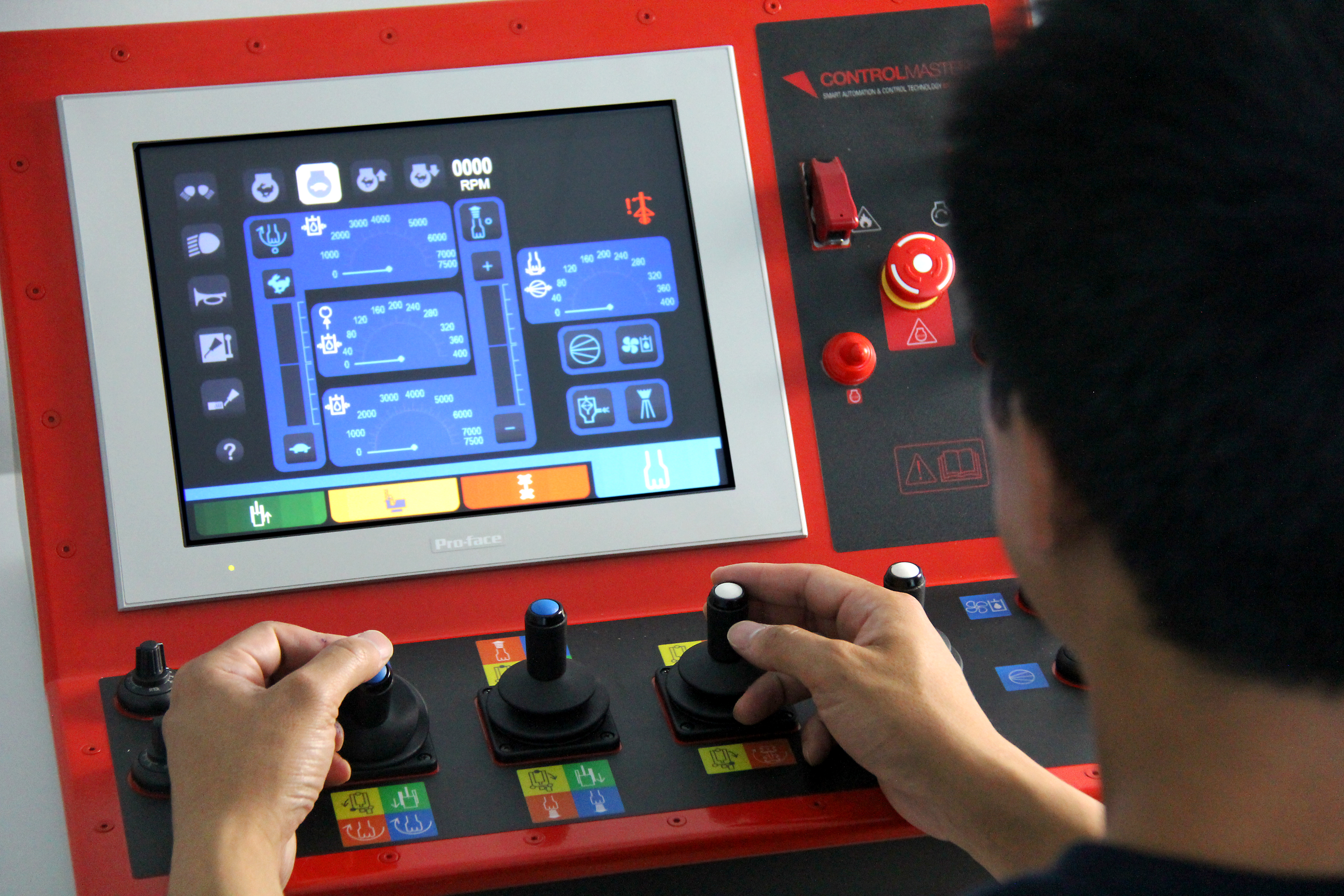
There’s a new member of the ControlMaster® family and it is automating surface drills.
Classic red in colour, this creation came about thanks to the Polyus project, but it looks to be a permanent member of the family when it was redesigned to be rolled out across all models of surface drills.
Although RCT has remoted surface drills in the past, the decision was made to reinvent the existing drill console.
“The original consoles were very big and took up a lot of space so we jumped at the chance at redesigning it for the Polyus project,” said RCT Custom’s Design Technician Jayden Rickert.
“RCT are constantly innovating and improving its solutions to ensure we are ahead of the curve and this project was no exception.”
Concept
The concept stage is one that involved extensive research and had Jayden reviewing numerous sources for more information.
“The Atlas Copco DML Series drill that the console would be installed on wasn’t available to me here so I had to improvise which was by far the hardest aspect of the project,” he said.
Jayden had to ensure the console would mimic all the functions of the model drill to ensure the progress was a success.
“RCT’s main goal with projects like this is to enable operators to control the machines with the same functionality as if they were sitting in the cab of the machine,” he said.
“There were a lot of factors to be taken into consideration with this project.”
“As technology has advanced, so has the ability to condense our ControlMaster® technology into a smaller console and still have the same functionalities we had previously.”
Once Jayden had drawn up the required specification in a detailed document and he was certain that they were in order, and then the Custom team knew exactly what was needed to carry out this project successfully.
“This included knowing the hardware required to fit out the new drill console, number of joysticks, display, inputs, parts etc.”
Jayden described the surface drill project as somewhat unique for RCT.
Outcome
The redesigned console consists of multiple joysticks and HMI (Human Machine Interface) which can be used over four different modes to perform 70+ functions.
It was an important requirement that the icons met ISO Standards and that they would translate well to into Russian but also have a universal meaning for future projects.
“Everything that we implemented on this console was to serve a specific function; it was important that we covered
for every eventuality, also to ensure that we had catered to every function and requirement that the operator would need.”
To further ensure operators have the same vision, if not a better view of the operating area, Jayden and the team added a full camera system which includes 5 fixed cameras and pan-tilt-zoom camera which are capable of remote directional and zoom control.
Although Jayden was the brainchild behind the project, he recognised the project was a team effort and it wouldn’t have been possible without the assistance of the Custom, Drafting and Marketing departments.
“In particular, RCT’s Technical Document Coordinator Clint Wilmot and his team – his Auto CAD drawings are so precise, which is exactly what I needed in order to make these concepts a reality,” he said.
“RCT’s Graphic Designer Gemma Twidle helped to create the drill ISO icons and designing a user interface for the console to ensure a seamless user experience, which turned out exceptionally well. It was easy to communicate what we wanted and Gemma had some great ideas.”
Of course, RCT’s Custom team were also heavily involved.
“I had an amazing team working with me to achieve this task which included Embedded Software Engineer, Tam Nguyen, Senior Embedded Software Engineer Nick Stanley, Design Technician Michael Godfrey and Apprentice Auto Electrician, Blake Laidler."
The end result was a modernised console that met all the criteria for this particular drill project but also lay down the foundations, to be adapted to various drills for years to come.
Installation
As well as leading the design and manufacture of the console, Jayden literally went the extra mile and flew to Polyus’ site in Russia to ensure the successful deployment of the console once it was installed on the drill. Jayden played an integral role in this project from start to finish and his exemplary diligence and capabilities were noticed. This project was a great example of a team member that went above and beyond to deliver our client the best solution possible.
The end result of this project was that the operator was able to match/improve on manual production times. From a safe, clean control station environment free from rock falls, explosives, constant machine vibration, diesel fumes, and dust and extreme weather conditions.